
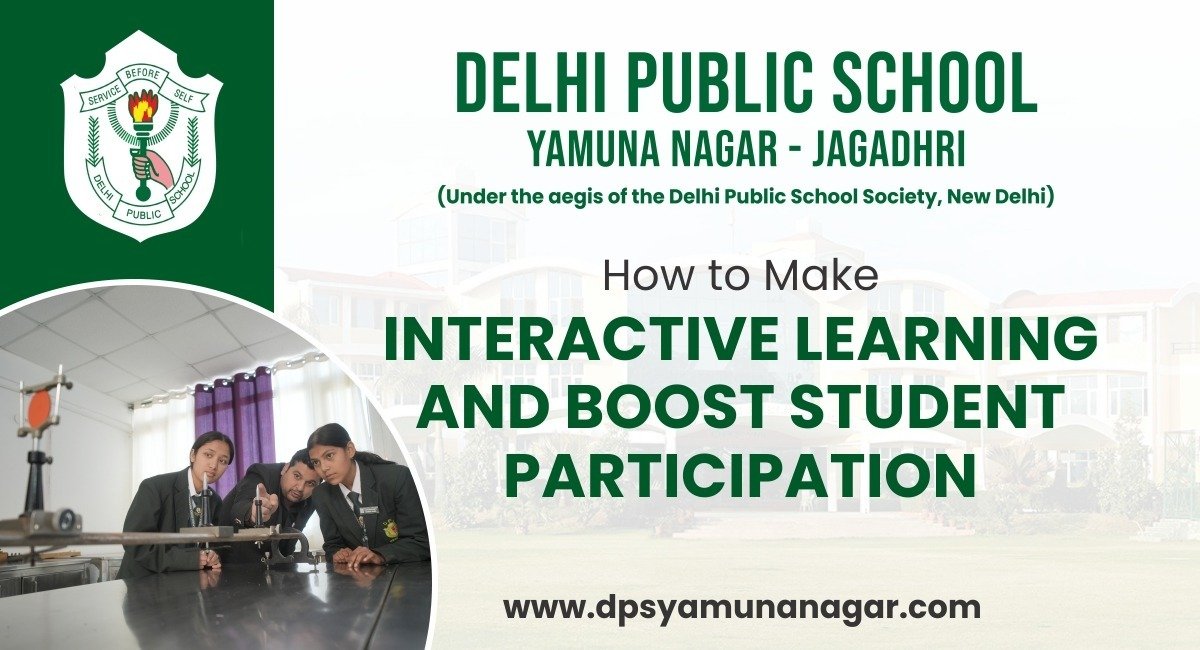
Education in the 21st century has transformed drastically from traditional textbook learning to dynamic, interactive experiences that involve students in meaningful ways. Among the institutions leading this educational evolution is Delhi Public School Yamunanagar, one of the Top Boarding Schools In India. The school has adopted innovative teaching methodologies to ensure every student is engaged, curious, and empowered to learn.
This blog explores how DPS Yamunanagar creates an interactive learning environment, enhances student participation, and fosters creativity through activities like the student science project initiatives and developing the best science model for class 6 learners.
Why Interactive Learning Matters
Interactive learning is more than just a teaching strategy—it’s a philosophy that shifts the focus from the teacher to the learner. It encourages critical thinking, collaboration, and problem-solving. Instead of passively receiving information, students at DPS Yamunanagar are active participants in their education. They engage in debates, perform science experiments, participate in quizzes, and use technology to understand real-world applications.
For a school that aims to rank among the Top Boarding Schools In India, providing such holistic learning experiences is a cornerstone of its success.
The DPS Yamunanagar Approach: Blending Innovation with Curriculum
At DPS Yamunanagar, interactive learning is embedded in every classroom. Here’s how:
1. Project-Based Learning
Students are encouraged to work on real-life problems, turning theoretical knowledge into practical application. Whether it’s math, science, or social studies, every subject includes hands-on projects. The student science project initiatives are especially popular. Students conduct research, experiment with different materials, and develop solutions to real-world challenges—often integrating concepts from multiple disciplines.
These projects not only deepen understanding but also help develop soft skills like teamwork, communication, and time management.
2. Technology-Enabled Classrooms
Smartboards, virtual labs, and educational software are integral to the learning process. Teachers at DPS Yamunanagar use interactive presentations, simulations, and videos to clarify complex concepts. This makes lessons more engaging and helps cater to different learning styles—auditory, visual, and kinesthetic.
Moreover, technology empowers students to collaborate virtually, explore beyond textbooks, and present their learnings in creative formats such as digital posters or video reports.
3. Hands-On Science Learning
Science is taught not as a subject but as an exploration. Labs at DPS Yamunanagar are well-equipped for both junior and senior students. For young learners, particularly those in class 6, the school organizes annual exhibitions where the best science model for class 6 is selected based on innovation, presentation, and understanding of the scientific principle.
Examples include water filtration systems, volcano models, solar-powered devices, and electric circuits—projects that spark curiosity and confidence in budding scientists.
Boosting Student Participation: Techniques That Work
Student participation doesn’t happen automatically—it needs to be cultivated. DPS Yamunanagar employs multiple strategies to ensure every child has a voice in the classroom.
1. Student-Led Discussions
In every subject, students are given opportunities to lead discussions, ask questions, and express opinions. This helps build confidence and improves critical thinking. For instance, in English literature classes, students are encouraged to interpret characters in their own way, while in science, they’re prompted to hypothesize results before conducting an experiment.
2. Gamified Learning
Learning is fun when it’s a game. Quizzes, puzzles, and online competitions are frequently held to make revision and assessments exciting. Platforms like Kahoot and Quizizz are used for real-time contests, increasing participation through healthy competition.
3. Role Play and Simulation
Students love to step into different roles—be it a historical figure, scientist, or entrepreneur. Through role-playing exercises, they understand diverse perspectives and make learning experiential. In a recent activity, class 6 students reenacted the life of inventors, connecting history with the student science project week. It was a delightful blend of storytelling and scientific insight.
4. Peer Teaching
When students teach each other, retention improves. At DPS Yamunanagar, senior students often mentor juniors, particularly during science exhibition preparations or model-making sessions. This peer interaction helps both groups—seniors reinforce their knowledge while juniors benefit from simplified explanations.
Celebrating Creativity: The Science Exhibition
One of the most anticipated events at DPS Yamunanagar is the Annual Science Exhibition. The highlight? The selection of the best science model for class 6. This event serves as a platform for students to present their student science project in front of peers, teachers, and even external judges.
Some outstanding projects presented in past years include:
- A model of a solar-powered irrigation system.
- A miniature windmill that generates electricity.
- A homemade water purifier using charcoal, sand, and gravel.
- A robotic hand made using syringes and pipes to demonstrate hydraulic power.
These projects, though created by 11–12-year-olds, are often at par with senior-level efforts. It shows the power of nurturing young talent through proper guidance, resources, and encouragement.
Role of Teachers: Facilitators, Not Instructors
At DPS Yamunanagar, teachers don’t just instruct—they mentor. They guide students toward independent learning and ensure equal participation. Personalized attention is provided to students who are shy or hesitant to participate, ensuring inclusive classroom dynamics.
Moreover, teacher training is ongoing. Faculty members are regularly updated with the latest teaching methodologies and tech tools, keeping them aligned with global educational standards.
Parental Involvement and Community Learning
Another important pillar of interactive learning is parental involvement. DPS Yamunanagar believes in forming a triad of student, teacher, and parent. Regular workshops, orientation programs, and interactive sessions keep parents involved in their child’s academic journey.
Additionally, community-based projects, such as eco-clubs, tree plantation drives, and science camps, create opportunities for students to apply their knowledge in real-world scenarios while giving back to society.
Boarding Advantage: Extended Learning Hours
As one of the Top Boarding Schools In India, DPS Yamunanagar offers a unique advantage—extended hours of learning. After academic hours, students participate in club activities, supervised study sessions, and workshops, all of which reinforce classroom concepts. It also offers quiet time for reflective learning and personal exploration, often resulting in better academic and creative performance.
Boarding students are often the ones who participate most enthusiastically in science exhibitions and evening innovation labs. They get additional mentoring from hostel tutors, helping refine their student science project ideas into competition-worthy models.
Success Stories and Recognition
Several students from DPS Yamunanagar have represented the school at national-level science fairs and Olympiads. Many science models built in class 6 have gone on to win awards at regional contests, showcasing the school’s commitment to early talent development.
In recent years, the school was recognized in Haryana for promoting experiential STEM learning, further cementing its reputation as one of the Top Boarding Schools In India.
Final Thoughts: A Model for Future Education
Interactive learning is not just a buzzword at DPS Yamunanagar—it is a lived reality. From fostering scientific curiosity through student science projects to encouraging innovation with the best science model for class 6, the school is setting benchmarks in participatory education.
In an age where rote memorization no longer serves students, schools must create environments that encourage thinking, questioning, and creating. DPS Yamunanagar proves that with the right tools, vision, and community support, schools can ignite a lifelong love for learning—making education not only effective but also joyful.
Whether you’re a parent looking for the Top Boarding Schools In India, or an educator seeking inspiration, DPS Yamunanagar offers a blueprint for what true interactive education looks like in action.