
As technology transforms every industry, parents are increasingly looking for schools that prepare children for the future—not just through academics, but by developing innovation, creativity, and problem-solving skills. One of the biggest indicators of a future-ready school is its investment in Robotics and STEM (Science, Technology, Engineering, and Mathematics) education.
Today, many of the best boarding schools in India are integrating robotics labs, coding, artificial intelligence, design thinking, and experiential learning into their curriculum, enabling students to become confident learners and innovators from an early age.
If you are searching for a boarding school in India with dedicated robotics and STEM programs, this guide will help you understand what to look for and why it matters.
Why Are Robotics and STEM Education Important?
The careers of tomorrow will demand skills that go far beyond textbook knowledge. Robotics and STEM education encourage students to think critically, experiment, collaborate, and solve real-world problems.
Students participating in STEM-based learning develop:
- Logical and analytical thinking
- Creativity and innovation
- Coding and programming skills
- Engineering fundamentals
- Scientific inquiry
- Teamwork and collaboration
- Design thinking
- Confidence in solving practical challenges
These skills are valuable not only for careers in engineering and technology but also in medicine, research, business, entrepreneurship, and many other fields.
What Should Parents Look for in a STEM-Focused Boarding School?
Not every school with a computer lab offers meaningful STEM education. Parents should evaluate schools based on the quality of their innovation ecosystem.
Some important features include:
Dedicated Robotics Laboratory
A well-equipped robotics lab allows students to design, build, and program robots while learning engineering concepts through hands-on activities.
Coding and Programming Education
Students should receive age-appropriate exposure to coding languages, computational thinking, app development, and automation.
Innovation and Tinkering Spaces
Innovation labs encourage experimentation, prototyping, and creative problem-solving through project-based learning.
STEM-Based Learning Activities
The best schools integrate STEM into classroom learning through:
- Science experiments
- Engineering projects
- Mathematical modelling
- Robotics competitions
- Innovation challenges
- Research-based assignments
Participation in National Competitions
Schools that encourage participation in robotics competitions, science exhibitions, Olympiads, and innovation events provide students with valuable exposure beyond the classroom.
Benefits of Learning Robotics in a Boarding School
Boarding schools provide a structured environment where students have more opportunities to explore their interests after regular classroom hours.
Some key advantages include:
More Time for Practical Learning
Residential students benefit from dedicated activity periods, supervised lab sessions, club activities, and innovation workshops.
Collaborative Learning Environment
Living and learning together encourages students to work on projects as teams, improving communication and leadership skills.
Continuous Teacher Guidance
Students receive ongoing mentorship from teachers and activity coordinators who help them complete projects, participate in competitions, and develop technical confidence.
Better Time Management
The disciplined routine of a boarding school helps students balance academics, sports, extracurricular activities, and STEM learning effectively.
How STEM Education Supports Future Careers
Early exposure to robotics and innovation prepares students for higher education and emerging career opportunities in:
- Artificial Intelligence (AI)
- Robotics Engineering
- Computer Science
- Data Science
- Electronics
- Mechanical Engineering
- Aerospace Engineering
- Biomedical Engineering
- Automation
- Research and Development
- Entrepreneurship
Even students pursuing non-technical careers benefit from the analytical thinking and problem-solving mindset developed through STEM education.
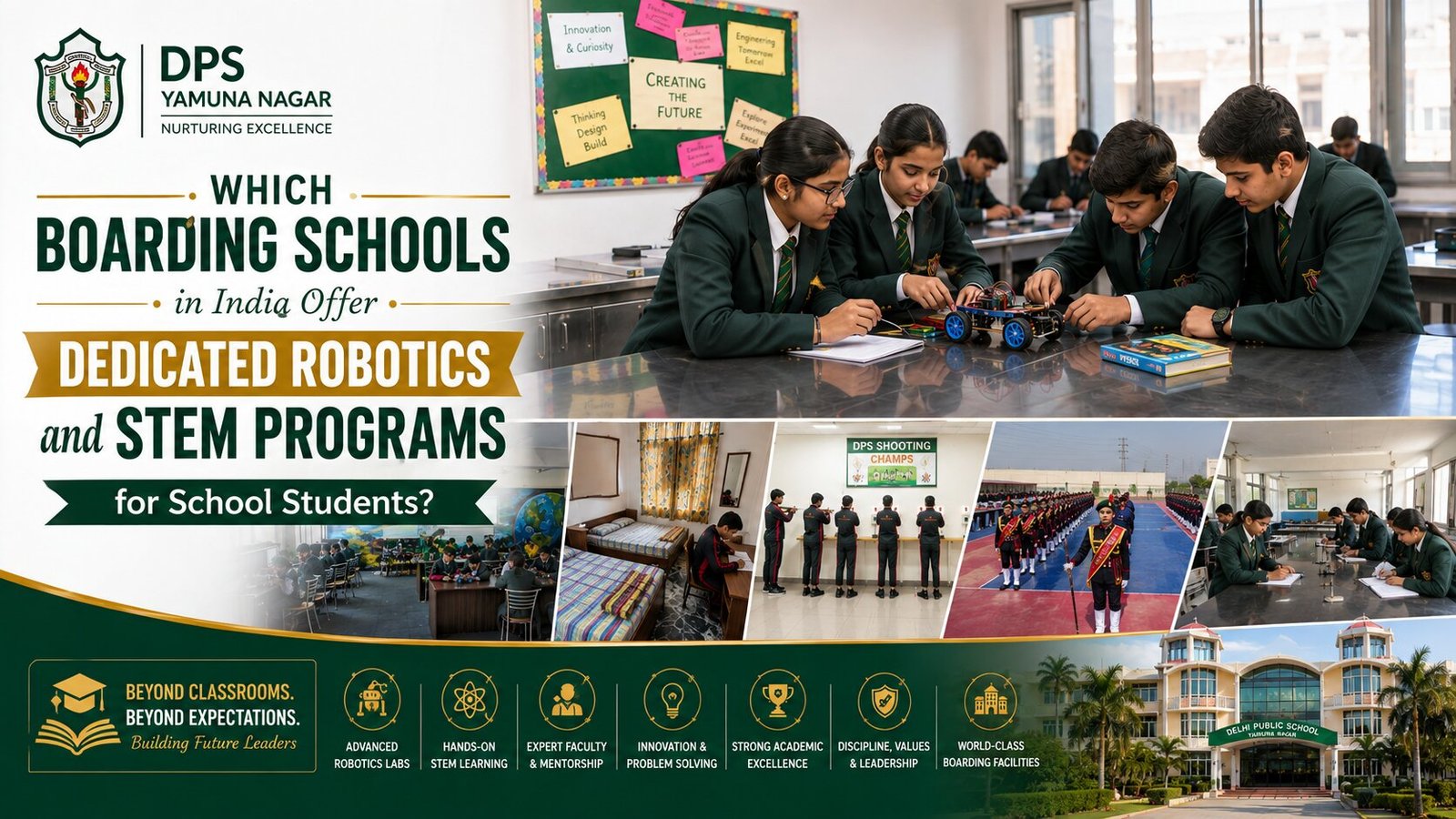
Delhi Public School Yamunanagar: Encouraging Innovation Through Robotics and STEM
Among the leading CBSE boarding schools in North India, Delhi Public School Yamunanagar has embraced technology-driven learning by providing students with opportunities to explore robotics and STEM education as part of their overall academic development.
The school offers an environment where innovation is encouraged through:
- A dedicated Atal Tinkering Lab (ATL) for hands-on STEM learning
- Robotics and coding activities
- Science and technology projects
- Practical experimentation
- Inquiry-based classroom learning
- Participation in innovation-focused activities
- Experienced faculty guiding students in modern learning methodologies
Along with strong academics, students also benefit from a structured residential environment that gives them the time, resources, and mentorship to explore their interests beyond the classroom.
Why Boarding Schools Are Ideal for STEM Education
A residential campus creates learning opportunities throughout the day—not just during school hours.
Students can participate in:
- Evening robotics sessions
- STEM clubs
- Innovation challenges
- Science exhibitions
- Coding workshops
- Collaborative research projects
- Technology competitions
This extended exposure allows students to develop confidence and technical skills that are difficult to achieve in a traditional day-school schedule.
Questions Parents Should Ask Before Choosing a STEM Boarding School
Before finalising admissions, consider asking:
- Does the school have a dedicated robotics or STEM laboratory?
- Are coding and robotics included in the curriculum or offered as clubs?
- Do students participate in innovation competitions and science exhibitions?
- Are teachers trained to guide STEM-based projects?
- Does the school encourage experiential and project-based learning?
- Are students given opportunities to work on real-world challenges?
- Is technology integrated into everyday classroom teaching?
These questions can help parents identify schools that genuinely invest in future-ready education.
Final Thoughts
Robotics and STEM education are no longer optional—they are becoming essential components of modern schooling. Boarding schools that integrate technology, innovation, and experiential learning help students develop the knowledge and skills needed for tomorrow’s world.
Schools such as Delhi Public School Yamunanagar combine academic excellence with robotics, STEM learning, and a nurturing residential environment, enabling students to grow into confident thinkers, innovators, and responsible future leaders.
When choosing a boarding school, parents should look beyond examination scores and consider how well the school prepares students for the rapidly changing world they will enter after graduation.
Frequently Asked Questions (FAQs)
1. What is STEM education in schools?
STEM education combines Science, Technology, Engineering, and Mathematics through practical, interdisciplinary learning that develops analytical thinking and problem-solving skills.
2. Why is robotics important for school students?
Robotics introduces students to coding, engineering, automation, and innovation while improving creativity, teamwork, and logical reasoning.
3. Do boarding schools provide better opportunities for STEM learning?
Many boarding schools offer extended access to robotics labs, innovation clubs, coding sessions, and project-based learning, allowing students more time to explore technology beyond classroom hours.
4. What is an Atal Tinkering Lab?
An Atal Tinkering Lab (ATL) is an innovation workspace established under the Government of India’s Atal Innovation Mission. It encourages students to experiment with robotics, electronics, coding, 3D design, and other STEM technologies through hands-on projects.
5. How can parents identify a good STEM-focused boarding school?
Parents should evaluate the availability of robotics labs, STEM infrastructure, experienced faculty, innovation programmes, coding education, participation in competitions, and opportunities for experiential learning before making an admission decision.